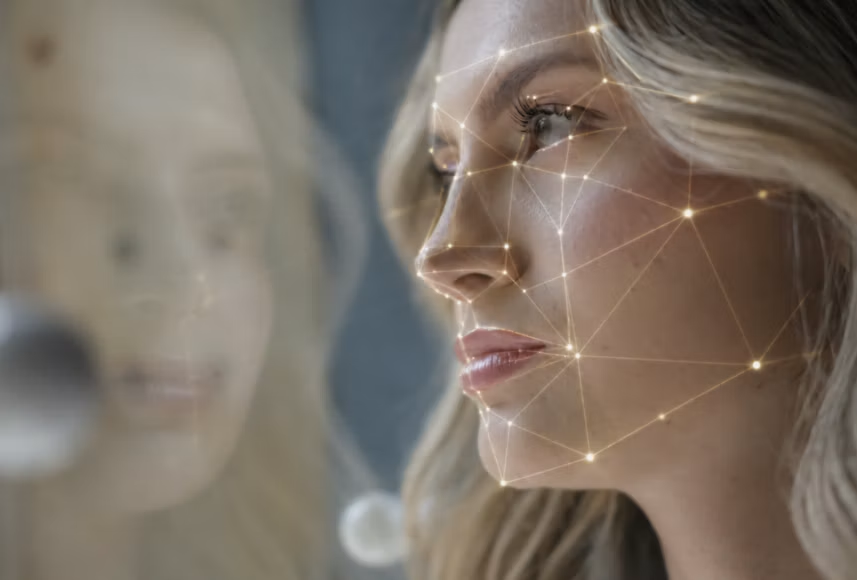
In an age where algorithms can diagnose diseases, compose symphonies, and drive cars, it was only a matter of time before artificial intelligence turned its analytical gaze toward one of humanity’s most enduring obsessions: beauty. The question “how attractive am I artificial intelligence” has evolved from a sci-fi curiosity to a tangible reality, with AI-powered tools now claiming to quantify, score, and enhance human attractiveness.
But can a machine truly capture the essence of beauty? This comprehensive guide explores the fascinating intersection of artificial intelligence and human aesthetics, examining the technology behind attractiveness AI, its accuracy, limitations, and the broader implications for society.
Understanding Attractiveness AI: What It Is and How It Works
Attractiveness AI refers to artificial intelligence systems designed to analyze, score, and sometimes enhance human physical appearance based on facial features and aesthetic criteria. These systems use sophisticated machine learning algorithms, particularly deep learning and computer vision, to evaluate facial photographs and assign attractiveness ratings or provide improvement recommendations.
The technology behind these tools is rooted in decades of research on facial aesthetics and computational analysis. When you ask “how attractive am I artificial intelligence,” you’re essentially submitting your facial data to complex neural networks trained on thousands—sometimes millions—of human faces and their corresponding attractiveness ratings.
The Technology Behind Beauty Analysis
The core of AI attractiveness scoring relies on several key technologies:
Convolutional Neural Networks (CNNs): These deep learning algorithms excel at processing visual data. CNNs can identify specific facial features—symmetry, skin texture, bone structure proportions, and more—by analyzing pixel patterns and edge detection across multiple layers of abstraction.
Computer Vision: This technology enables AI to “see” and interpret visual information from photographs. Advanced vision models can detect subtle facial characteristics that might escape human notice, such as micro-expressions, skin quality variations, and precise facial geometry.
3D Facial Reconstruction: Some advanced systems can create three-dimensional models of faces from 2D images, enabling more comprehensive analysis of facial structure, depth, and proportion. The 3DFACENet system, for instance, uses 3D shape and texture coefficients to assess attractiveness with state-of-the-art accuracy.
Data Training: AI models learn from large datasets of faces that have been rated by human observers. The SCUT-FBP5500 dataset is commonly used in academic research, containing thousands of faces with multiple attractiveness ratings.
What Attractiveness AI Looks For
When you ask “how attractive am I artificial intelligence,” the algorithms examine numerous factors:
Facial Symmetry: Research has long associated symmetry with perceived attractiveness, as it may signal genetic health and developmental stability.
Averageness: Paradoxically, faces that are mathematically average (closer to population norms for various features) are often rated as more attractive.
Skin Quality: Evenness of skin tone, smoothness, and lack of blemishes are typically weighted heavily in AI models.
Facial Proportions: The “Golden Ratio” (approximately 1:1.618) has been historically considered an ideal proportion in facial aesthetics, though recent research suggests its importance may be overstated.
Sexual Dimorphism: AI models often evaluate features associated with masculinity or femininity according to cultural norms, such as jawline sharpness in men or lip fullness in women.
Age Perception: Many AI tools attempt to estimate age as a component of attractiveness assessment, with different scoring patterns emerging for different age groups.
Popular Attractiveness AI Tools and Their Features
The market has responded enthusiastically to consumer curiosity about AI-driven attractiveness analysis. Several applications and services now allow users to upload their photos and receive instant feedback.
Smartphone Applications
Attractiveness AI (iOS): This app offers comprehensive facial analysis, including age perception insights and photo enhancement suggestions. It emphasizes privacy, stating that images are processed securely and not stored.
Look & Style Report: Available on Google Play, this app provides advanced analysis of face shape, skin quality, jawline structure, hair, and masculinity/femininity ratings. A PRO subscription unlocks more sophisticated analysis models.
Attractiveness Test: Another popular Android option that rates faces on a 1-10 scale and predicts age and gender. The developer explicitly states that the tool is for entertainment purposes only, not a genuine measure of human worth.
What You Get from These Tools
Most attractiveness AI applications provide:
-
Numerical Ratings: Typically a score from 1-10, indicating how attractive the AI considers the face.
-
Feature Breakdowns: Specific ratings for individual features like eyes, nose, lips, and jawline.
-
Symmetry Analysis: An assessment of facial symmetry, often highlighted as a key factor.
-
Celebrity Look-Alikes: Some apps identify which famous person your face most resembles.
-
Improvement Suggestions: Recommendations for skincare, grooming, or style changes to enhance appearance.
-
Photo Optimization Tips: Advice on lighting, angles, and composition for better photos.
The Accuracy Question: How Reliable Is Attractiveness AI?
This is perhaps the most critical question when considering “how attractive am I artificial intelligence.” The answer is nuanced and requires understanding both the capabilities and limitations of current technology.
What Research Reveals
A 2025 study published in the Journal of Plastic, Reconstructive & Aesthetic Surgery examined the consistency between AI facial aesthetic scores and human preferences. The study found that AI scores showed a “good overall correlation with manual scores” and the AI demonstrated high accuracy in classifying high and low facial aesthetic scores.
The researchers concluded that AI facial aesthetic scoring technology demonstrates “good application potential” and could “serve as an objective aesthetic evaluation tool for clinical aesthetic assessments.” This suggests that, in some contexts, AI is approaching human-level consistency in aesthetic judgments.
However, the study also noted only “moderate consistency between AI and manual scores,” indicating that while AI is often aligned with human judgments, there remains significant room for variance.
The Bias Challenge
A critical limitation of AI attractiveness tools is their susceptibility to bias. A study from the University of Virginia’s School of Data Science found that AI models analyzing facial features showed “demographic variation, not mathematical proportion, as the strongest factor shaping model outputs.” This means that differences in age, ethnicity, and other demographic factors can significantly influence AI scoring, potentially reflecting biases in the data used to train these systems rather than universal standards of beauty.
The researchers emphasized that “attempts to quantify beauty often reveal more about representation and bias than any universal standard.” This finding reinforces that when you ask “how attractive am I artificial intelligence,” the answer you receive is influenced by the particular dataset used to train that AI model.
Similarly, AI systems have been found to perpetuate harmful stereotypes. One study highlighted that text-to-image models generated images reflecting biased beauty standards, “underscoring the influence of societal norms on AI and the risk of perpetuating harmful stereotypes or unrealistic beauty standards.”
The Subjectivity Problem
Beauty is fundamentally subjective. What one culture finds attractive, another may not. Even within the same culture, personal preferences vary dramatically. A 2025 study on facial attractiveness perception using AI and human analysis explored the role of dynamic facial expressions and how they influence judgments, demonstrating that even subtle contextual factors can significantly affect attractiveness ratings.
AI models trained on specific datasets inevitably reflect the aesthetic preferences of the raters who labeled those datasets, typically people from particular cultural backgrounds. This means the answer to “how attractive am I artificial intelligence” may differ dramatically depending on which AI tool you use.
The 0-10 Scale Controversy
Some AI systems, like certain versions of ChatGPT, can be prompted to assign 0-10 attractiveness scores. As one expert noted, this can lead to problematic outcomes, including rapid attractiveness drop-off for women compared to men based on age. This echoes similar issues identified with earlier platforms like Beauty.AI, which faced significant criticism for biased results.
The Psychology Behind Asking “How Attractive Am I Artificial Intelligence?”
Understanding why people turn to AI for attractiveness assessment reveals important insights about human psychology in the digital age.
The Appeal of “Objective” Validation
Human judgments about appearance are notoriously biased by personal relationships, cultural context, and individual preferences. AI offers the seductive promise of objectivity—an impartial, algorithmic assessment free from human prejudice and social niceties.
This appeal is particularly strong in an era where social media has made appearance increasingly central to social identity. Many people seeking an answer to “how attractive am I artificial intelligence” are looking for confirmation or validation of their self-perception.
Entertainment and Curiosity
For many users, attractiveness AI is simply fun. The novelty of having an algorithm judge your appearance, the entertainment value of celebrity look-alike features, and the curiosity about how these systems work all drive engagement. The “Attractiveness AI” iOS app, for example, markets itself as “an innovative way to explore and enhance your personal appearance” with “supportive and constructive insights.”
Social Comparison and Self-Improvement
Some users approach attractiveness AI as a tool for self-improvement. The detailed feature analysis provided by many apps can be seen as a roadmap for enhancement—recommendations for skincare, grooming, or style changes that could make a person more appealing to others.
This self-improvement angle can be constructive when approached with the right mindset. However, it also carries risks of excessive self-scrutiny and unrealistic expectations.
The Self-Esteem Factor
The relationship between attractiveness AI and self-esteem is complex. For people with secure self-perception, a low AI rating might be dismissed as a flaw in the algorithm. For those already struggling with body image issues, however, an unflattering AI assessment could reinforce negative self-perceptions.
This is why many apps include disclaimers. The “Attractiveness Test” app on Google Play states: “This app is designed solely for entertainment and should not be used as a genuine measure of someone’s worth or attractiveness. Every individual is unique, and true beauty is multifaceted and subjective.”
The Deeper Dimension: Beyond Physical Appearance
When considering “how attractive am I artificial intelligence,” it’s important to recognize what current AI tools cannot measure.
Personality and Charisma
Physical appearance is only one component of human attractiveness. Qualities like humor, intelligence, kindness, confidence, and charisma often outweigh physical features in determining overall appeal, particularly in real-world relationships.
AI tools are currently incapable of evaluating these intangible qualities from photographs. A person who might receive a modest score from attractiveness AI could be exceptionally attractive to others based on their personality and presence.
The Romantic Attractiveness of AI Agents Themselves
Interestingly, research has explored the inverse question: can AI agents be perceived as romantically attractive? A study published in the International Journal of Human-Computer Interaction found that virtual romantic relationships are primarily characterized by “chat-based Platonic love,” where individuals establish these connections primarily to fulfill romantic needs.
The study highlighted that “perceived dialogue authenticity and anthropomorphism are vital factors attracting users to virtual agents,” suggesting that emotional connection and perceived humanness matter more than physical attributes even in AI-human relationships.
Dynamic Factors
Human attractiveness is dynamic, influenced by movement, expression, and context. A person’s smile, posture, gestures, and eye contact can dramatically affect how attractive they appear. Current AI tools analyzing static photographs cannot account for these dynamic qualities.
Research on “dynamic facial expressions in judgment of attractiveness” has demonstrated that how a face moves and expresses emotion significantly influences perceived attractiveness, suggesting that static image analysis provides an incomplete picture.
The Business of Beauty AI
The AI attractiveness industry is growing rapidly, with numerous apps and services monetizing human curiosity about appearance.
The Cost of AI Beauty Analysis
Most attractiveness apps operate on a freemium model:
-
Free version: Basic analysis with limited features and sometimes less sophisticated AI models.
-
Premium subscription: Advanced analysis, more detailed reports, and sometimes better AI models. The iOS “Attractiveness AI” app offers a Pro subscription for a monthly fee.
-
Data monetization: Some free services may collect user data for marketing or training purposes, though privacy policies vary significantly.
What Your Photo Data Might Be Used For
Privacy concerns are legitimate when using attractiveness AI. Many services claim they don’t store user images. The “Attractiveness AI” app, for instance, promises: “All images are analyzed securely and are never stored or shared. We are committed to ensuring that your personal data remains safe.”
However, users should always review privacy policies carefully. Some apps may use uploaded images to train and improve their AI models, potentially allowing your facial data to become part of commercial datasets.
Beyond Ratings: How Attractiveness AI Is Changing Industries
The ability to algorithmically evaluate appearance has applications far beyond consumer curiosity.
Medical and Aesthetic Medicine
AI facial attractiveness scoring shows significant potential in clinical settings. Research has explored whether AI-assisted objective scoring systems can “replace manual aesthetic evaluations,” with results suggesting “good application potential” for “clinical aesthetic assessments.”
This could allow plastic surgeons and aesthetic practitioners to provide more objective assessments and treatment recommendations, potentially improving patient outcomes and satisfaction. However, these clinical applications require careful validation and quality control.
Content Creation and Social Media
AI tools can help content creators select their most flattering images for social media. Features that evaluate “lighting, composition, and framing” and provide “easy, actionable tips how to improve your photos” help users optimize their online presence.
Entertainment and Gaming
The development of virtual reality, augmented reality, and 3D games has driven research into 3D facial attractiveness computation. The 3DFACENet system, for example, was specifically designed to support “facial editing, virtual makeup, AR/VR technologies and 3D games applications.”
Practical Advice for Using Attractiveness AI
If you’re considering asking “how attractive am I artificial intelligence,” here’s how to approach these tools with a healthy mindset.
When It’s Appropriate to Use Attractiveness AI
-
For entertainment and curiosity: These tools can be fun to try out with friends.
-
For specific improvement goals: Use the detailed feature analysis to identify potential areas for skincare or grooming changes.
-
For photo selection: When choosing profile pictures for dating apps or social media, AI can help identify which photos are most flattering.
-
For understanding the technology: If you’re interested in AI and computer vision, these tools offer a glimpse into how algorithms process visual information.
When to Be Cautious
-
Avoid as a measure of self-worth: Remember the disclaimers—these tools are for entertainment, not genuine assessments of your value.
-
Don’t obsess over scores: Repeated testing can feed anxiety and unrealistic standards.
-
Be aware of demographic bias: Understand that AI may not fairly evaluate all ethnicities or age groups.
-
Protect your privacy: Review privacy policies before uploading photos.
Tips for Getting the Most Out of Attractiveness AI
Use good quality photos: Results are only as good as the input. Use well-lit, clear, front-facing photos.
Try multiple tools: Different AI systems trained on different datasets will produce different results. Comparing several can provide a more balanced perspective.
Focus on specific feedback: The most useful information may not be the overall rating but specific insights about facial features.
Consider cultural context: Results reflect the cultural biases of the training data. If you’re from a culture underrepresented in popular datasets, the results may be less meaningful.
Use feedback constructively: If recommendations suggest skincare changes or grooming adjustments, these might be beneficial for skin health and self-presentation regardless of AI scoring.
The Future of Attractiveness AI
The technology is evolving rapidly, with several exciting developments on the horizon.
Enhanced 3D Analysis
Current systems primarily analyze 2D images, but 3D facial reconstruction is advancing quickly. The 3DFACENet system represents a significant step forward, using “3D shape and texture coefficients rather than 3D mesh models to access facial attractiveness” while “balancing aesthetic enhancement and identity preservation.”
This technology could eventually enable more sophisticated analysis and even virtual aesthetic augmentation.
AI-Augmented Reality
Integration with AR could allow real-time attractiveness analysis and enhancement. Future systems might overlay recommended improvements on live video feeds, providing instant feedback on angles, expressions, and styling choices.
More Diverse and Inclusive Models
As researchers recognize the bias problem in AI attractiveness systems, efforts are increasing to create more diverse training datasets that better represent global diversity in facial features and beauty standards.
The University of Virginia study emphasized the “importance of diverse, representative datasets and critical evaluation of model assumptions.” This focus on inclusivity will be essential for the future credibility of these tools.
Integration with Healthcare
AI attractiveness analysis may increasingly integrate with health monitoring. Skin quality assessment, for instance, could provide insights beyond cosmetic appearance, potentially identifying early signs of skin conditions or overall health issues.
Frequently Asked Questions About Attractiveness AI
Can AI Accurately Judge Beauty?
Research suggests AI can approximate human aesthetic judgments with moderate to good correlation. However, accuracy varies significantly depending on the specific AI model, training data, and the face being analyzed. No AI can capture the full complexity of human beauty perception.
Why Do Different AI Tools Give Different Results for the Same Photo?
Different AI models are trained on different datasets and use different algorithms. A face that scores highly on one system might score lower on another, reflecting the specific biases and approaches of each system. This variation underscores the subjectivity inherent in beauty assessment.
Is AI Attractiveness Analysis Safe for My Privacy?
This depends entirely on the specific app or service. Some prioritize privacy, analyzing photos locally on your device without uploading them to servers. Others may store or use your images. Always check the privacy policy before using any facial analysis tool.
Should Children Use Attractiveness AI Tools?
Most apps are intended for adults or at least older teens. Children and young teenagers are still developing their self-concept and may be particularly vulnerable to the effects of AI attractiveness ratings. It’s generally advisable to monitor or restrict such tools for minors.
Could My Employer or Insurer Use Attractiveness AI?
This is a legitimate concern for the future. While currently unlikely, the potential misuse of attractiveness AI in employment, insurance, or other non-consensual contexts is a risk. It’s one reason why regulation around AI and facial analysis is becoming increasingly important.
Beauty Standards Across Cultures: Why AI Struggles with Diversity
The question “how attractive am I artificial intelligence” becomes even more complex when we consider the vast differences in beauty standards across global cultures.
Western Beauty Standards in AI Training
Many AI attractiveness tools are trained predominantly on Western facial datasets. This means they often favor features common in European and North American populations—narrower noses, lighter skin tones, and specific facial proportions. A person with features highly valued in East Asian or African cultures might receive lower scores simply because the AI hasn’t been adequately trained on those facial types.
The Evolution of Beauty Standards
Beauty standards are not static. They evolve over time, influenced by media, fashion, cultural exchange, and social movements. AI models trained on data from a specific time period may reflect outdated standards that no longer align with contemporary aesthetics.
The recent movement toward body positivity and diverse representation has challenged traditional beauty norms, yet AI systems often lag behind these cultural shifts, perpetuating older, narrower standards.
Regional Variations
What is considered attractive varies significantly by region:
-
East Asia: Often emphasizes clear, pale skin, small faces, and delicate features. Double eyelids and V-shaped jawlines are frequently valued.
-
South Asia: Preferences vary widely but often include full hair, expressive eyes, and specific skin tones depending on region and community.
-
Africa: Beauty standards are incredibly diverse across the continent but often value full figures, elaborate hairstyles, and distinctive facial features.
-
Latin America: Often emphasizes curvaceous bodies, thick hair, and expressive facial features.
-
Middle East: Frequently values strong eyebrows, thick hair, and specific eye shapes.
AI trained on a single cultural dataset cannot adequately capture this diversity.
The Ethics of AI Attractiveness Scoring
As the question “how attractive am I artificial intelligence” becomes more common, ethical considerations grow increasingly important.
The Problem of Reinforcement
AI attractiveness tools risk reinforcing harmful beauty standards. By consistently rating certain features as more attractive, these systems can contribute to the marginalization of people who don’t fit narrow beauty ideals. This is particularly concerning for young people who may be more susceptible to these algorithmic judgments.
Privacy and Consent
Facial analysis involves processing highly personal biometric data. Users may not fully understand how their images are being used, stored, or shared. There are also concerns about consent when images are used to train AI models without explicit permission.
The Objectification Concern
Reducing human attractiveness to a numerical score can promote objectification. When people use the answer to “how attractive am I artificial intelligence” to define their self-worth, they may overlook the many other qualities that make them valuable as human beings.
Regulatory Landscape
Different countries are taking varying approaches to AI facial analysis regulation:
-
European Union: The EU’s AI Act classifies facial recognition and biometric analysis as high-risk applications, requiring strict compliance with transparency and accountability standards.
-
United States: Regulation varies by state, with some states restricting facial analysis in certain contexts, such as employment or housing decisions.
-
China: Has implemented strict regulations on facial recognition and biometric data collection.
-
Other regions: Many countries are still developing their regulatory frameworks for AI facial analysis.
Responsible AI Development
Researchers and developers have proposed several principles for responsible attractiveness AI:
-
Transparency: Users should understand what the AI is analyzing and how it works.
-
Diverse training data: Datasets should represent global diversity in facial features and beauty standards.
-
Contextual disclaimers: Tools should clearly state their limitations and entertainment purposes.
-
User control: Users should have control over their data and the ability to delete it.
-
Regular auditing: AI systems should be regularly tested for bias and accuracy.
Practical Scenarios: When People Ask “How Attractive Am I Artificial Intelligence”
To understand the real-world relevance of this question, let’s explore specific scenarios where people might turn to attractiveness AI.
Scenario 1: Dating App Profile Optimization
Sarah, a 28-year-old professional, is preparing to update her dating app profiles. She wants to know which photos present her most attractively. By using an attractiveness AI tool, she can analyze multiple photos to identify which ones score highest. She then uses the specific feedback about lighting and angle to take new, more flattering photos. While Sarah understands the AI’s limitations, she finds it useful as one data point in her decision-making.
Scenario 2: Curiosity and Self-Reflection
James, a 35-year-old marketing manager, has always wondered about his perceived attractiveness. He knows attractiveness is subjective but feels curious about what an “objective” assessment might reveal. He tries several AI tools, getting different scores ranging from 6 to 8. James takes the results lightly, enjoying the novelty and the specific feedback about his facial symmetry, but doesn’t let the scores affect his self-esteem.
Scenario 3: Social Media Content Creation
Maya, a lifestyle content creator with 50,000 followers, wants to improve her engagement. She uses AI attractiveness analysis to understand which of her photos are most visually appealing to a broad audience. The AI’s recommendations about lighting and composition help her create better-looking content, and she sees a modest increase in engagement. Maya emphasizes that her content’s value goes beyond appearance, but she appreciates the tool for professional improvement.
Scenario 4: Clinical Consultation
Dr. Chen, a plastic surgeon, uses AI facial analysis as part of his consultation process with patients seeking aesthetic procedures. The AI provides objective data on facial proportions and symmetry, helping patients understand potential improvement areas. Dr. Chen emphasizes that the AI is a supplement to, not a replacement for, his clinical judgment and the patient’s personal aesthetic goals.
Scenario 5: Entertainment Among Friends
A group of college friends downloads an attractiveness AI app during a social gathering. They take turns analyzing their photos, laughing at celebrity look-alike results and comparing scores. The activity is lighthearted, and everyone understands it’s for fun. The conversation naturally shifts to the limitations of AI beauty analysis, and the friends appreciate the tool as a conversation starter rather than a serious assessment.
Making Smart Decisions About Attractiveness AI Usage
When deciding whether to explore the question “how attractive am I artificial intelligence,” consider these practical guidelines.
Do’s and Don’ts
| Do | Don’t |
|---|---|
| Use the tools for entertainment and curiosity | Take scores as definitive judgments of your worth |
| Pay attention to specific feature feedback | Obsessively retest to try to improve your score |
| Compare results across multiple tools | Compare your scores with others competitively |
| Read privacy policies before uploading photos | Upload photos to untrusted or unknown services |
| Use feedback constructively for self-improvement | Let low scores damage your self-esteem |
| Understand the AI’s cultural limitations | Assume the AI is unbiased or universally valid |
| Treat the experience as a conversation starter | Overvalue algorithmic assessment over human feedback |
When to Step Back
Consider taking a break from attractiveness AI if you notice:
-
Feeling anxious or depressed after seeing your results
-
Compulsively checking or rechecking your scores
-
Comparing your scores to others in unhealthy ways
-
Letting recommendations drive excessive appearance-related behaviors
-
Feeling that your self-worth is tied to your AI attractiveness rating
Alternative Approaches to Self-Image
Instead of relying on AI to define your attractiveness, consider these healthier approaches:
Seek authentic feedback: Ask trusted friends and family for honest, balanced input about your appearance and presence.
Focus on controllable factors: Instead of obsessing over unchangeable features, invest in skincare, fitness, style, and grooming that make you feel confident.
Cultivate presence: Develop qualities like confidence, warmth, humor, and charisma that make you attractive in ways AI can’t measure.
Practice self-compassion: Recognize that everyone has unique features and that beauty standards are culturally constructed and constantly changing.
Remember the whole picture: Your value as a person goes far beyond physical appearance. Relationships, accomplishments, character, and contributions matter immensely.
Conclusion: Beyond the Algorithm
As we’ve explored throughout this comprehensive guide, the question “how attractive am I artificial intelligence” opens up a fascinating window into the intersection of technology and human self-perception. The answer you receive—whether a favorable 9.5 or a humbling 4.2—says as much about the biases embedded in the AI system as it does about your actual appearance.
Key Takeaways
AI attractiveness scoring can provide interesting insights and specific feedback about facial features, but it should never be taken as definitive truth. The correlation between AI and human ratings, while significant, is far from perfect.
Cultural and demographic bias is a significant limitation of current AI systems. Results should always be interpreted with this context in mind.
True attractiveness is multidimensional and subjective, encompassing personality, expression, dynamism, and countless other factors AI cannot yet measure. The best use of these tools is for curiosity, entertainment, and constructive self-improvement—never as a benchmark of personal worth.
Privacy must be prioritized when using any facial analysis tool. Review policies carefully and choose services that respect your data rights.
Ethical considerations matter. As AI becomes more integrated into how we perceive ourselves and others, we must advocate for responsible development, diverse datasets, and appropriate regulation.
Actionable Steps
If you’re curious, try one or two reputable attractiveness AI apps. Approach the experience with a playful, experimental mindset rather than seeking serious validation.
Focus on actionable feedback rather than overall scores. Use specific insights about skin quality, symmetry, or photo composition for practical improvements.
Consider multiple perspectives. Ask trusted friends for their honest opinions rather than relying solely on algorithmic assessment.
Remember the full picture. Physical appearance is just one aspect of who you are. Personality, character, and connection matter far more in human relationships than any AI can measure.
Stay informed about technology. As AI continues to evolve, understanding its capabilities and limitations becomes increasingly important for navigating a world where algorithms increasingly shape our self-perception.
Final Reflections
The question of attractiveness has captivated humanity for millennia. Now, artificial intelligence offers a new lens through which to examine this timeless topic. Used wisely, these tools can provide interesting insights and even helpful guidance. But the most valuable lesson they teach may be this: beauty, like the algorithms that attempt to measure it, is far more complex and multifaceted than any number can capture.
The real answer to “how attractive am I artificial intelligence” isn’t the score you receive—it’s understanding that you are more than any algorithm can measure, and that true attractiveness encompasses everything that makes you uniquely, beautifully human.