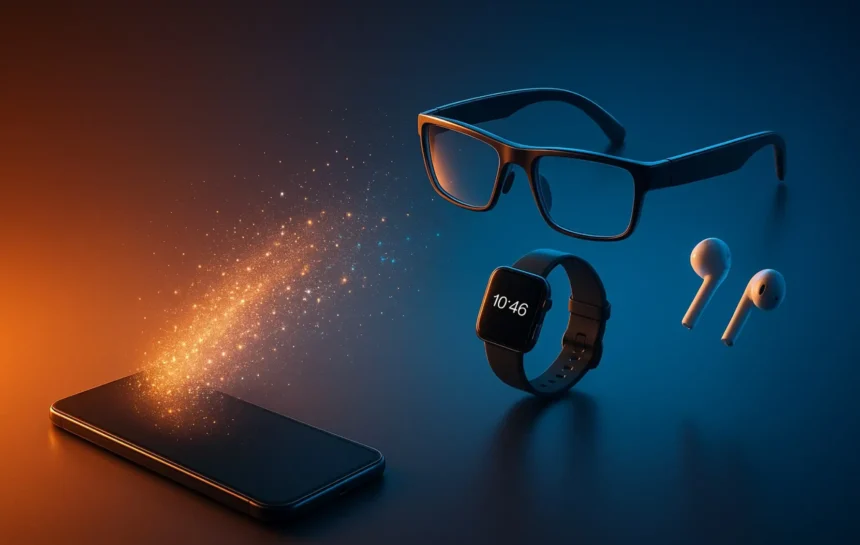
For over a decade and a half, the smartphone has reigned as the undisputed center of our digital lives. From the moment Apple unveiled the first iPhone in 2007, these pocket-sized devices have revolutionized how we communicate, work, navigate, and entertain ourselves. Yet, a quiet revolution is brewing in Silicon Valley and tech hubs worldwide. Tech giants envision future beyond smartphones —a future where our primary interface with technology shifts from screens we hold to devices we wear, speak to, or even think about.
This isn’t science fiction. It’s a transition already underway, driven by rapid advances in artificial intelligence, augmented reality, and miniaturized hardware. Industry leaders like Mark Zuckerberg, Elon Musk, Sam Altman, and Tim Cook hold starkly different visions for what comes next. Some predict immersive smart glasses that overlay digital information onto our physical world. Others imagine brain-computer interfaces that eliminate physical interaction with devices altogether. And some believe the smartphone will evolve rather than disappear.
This comprehensive article explores how tech giants envision future beyond smartphones, examining the emerging technologies, key players, potential benefits, challenges, and what this transformation means for everyday users. Whether you’re a technology enthusiast, industry professional, or simply curious about where digital innovation is headed, this guide provides an authoritative look at the post-smartphone world taking shape.
Why Tech Giants Are Looking Beyond Smartphones
The smartphone market, while still massive, has matured. Annual sales have plateaued, and year-over-year improvements have become incremental rather than revolutionary. Most consumers now upgrade their phones every three to four years rather than annually.
But more fundamentally, many tech leaders believe that tech giants envision future beyond smartphones because the smartphone itself imposes limitations on how we interact with technology. We must pull it from our pockets, unlock it, navigate through apps, and type or swipe to accomplish tasks. These friction points, while familiar, are increasingly seen as unnecessary in an age of intelligent assistants.
Modern AI assistants—far more capable than earlier voice helpers like Siri or Google Assistant—are poised to become the central operating system of personal computing. As noted in a recent Forbes report on AI integration, the operating systems we’re used to working with on phones will gradually fade into the background, where AI assistants will handle tasks automatically on our behalf. This shift means apps and polished interfaces may become less important when AI assistants can act on our behalf—automatically making plans with friends, generating shopping lists, or taking notes in meetings. The technology is moving from a tool we operate to an agent that operates for us.
The business incentive is equally compelling. New device categories represent entirely new markets, revenue streams, and opportunities to establish dominant positions. Companies that successfully define the next computing platform could reap rewards comparable to Apple’s smartphone success. This market evolution is similar to how personal computers transformed into the smartphone era, as documented by Wikipedia’s historical analysis of computing paradigms.
The Visionaries: How Different Leaders See the Future
Mark Zuckerberg and Meta’s Smart Glasses Bet
Among tech leaders, Mark Zuckerberg has been perhaps the most vocal and aggressive in proclaiming that tech giants envision future beyond smartphones through augmented reality glasses. He envisions a future where glasses become the primary computing device, making handheld screens obsolete.
“Glasses that understand our context because they can see what we see, hear what we hear, and interact with us throughout the day will become our primary computing devices,” Zuckerberg wrote in a letter posted on Meta’s website.
Meta’s progress in this direction includes the Ray-Ban Meta smart glasses, which have already surpassed 2 million sales. These glasses include a camera, speakers, and a microphone, with Meta AI built in to answer questions about what users are looking at—from zoo animals to historical landmarks.
More ambitious is Meta’s Orion prototype, which features screens built into the frame, allowing wearers to glance at information like digital notes while in conversation. According to The Verge’s coverage of Meta’s product roadmap, glasses without screens will likely become mainstream within two years, while those with digital displays remain further off due to technical challenges like battery life and design limitations.
Elon Musk and Neuralink’s Brain-Computer Interface
Elon Musk’s vision for life beyond smartphones is perhaps the most radical. Through his company Neuralink, Musk is developing brain-computer interfaces that allow users to control machines with their thoughts—no tapping, swiping, or even speaking required.
“In the future, there will be no phones, just Neuralinks,” Musk has predicted, suggesting that brain implants will enable people to communicate and interact with technology directly through thought.
Human trials have already begun, with two human subjects receiving implants. The company’s ambition is to eliminate physical interaction with devices altogether, integrating technology so seamlessly into human cognition that the device disappears entirely. The ethical considerations surrounding this technology have been extensively discussed in Wired publications, highlighting both the extraordinary potential and the significant risks.
While this vision faces significant technical hurdles and raises profound ethical questions about privacy, autonomy, and human identity, it represents the most extreme version of how tech giants envision future beyond smartphones.
Sam Altman and OpenAI’s Screenless Device
Sam Altman, CEO of OpenAI, is pursuing a middle path between glasses and brain implants. His company is reportedly developing a small, screenless device designed by former Apple chief designer Jony Ive—an endeavor some have dubbed the “iPhone of AI.”
Altman has partnered with SoftBank CEO Masayoshi Son to establish a fund of over $1 billion to finance the project. Unlike Musk’s brain implants, this device would be worn rather than implanted. Unlike glasses, it wouldn’t require looking at a screen.
Altman describes the experience of using it as resembling “sitting in a quiet lakeside cabin,” conveying a sense of calm and tranquility. He says the device will have “awareness of every aspect of our lives,” enabling it to determine the best time to send notifications without making users feel constantly monitored. OpenAI’s research into human-AI interaction has been thoroughly examined by TechCrunch, which notes that screenless interfaces represent a fundamental shift in how humans engage with digital information.
Bill Gates and Electronic Tattoos
Bill Gates is backing yet another vision through Chaotic Moon, a Texas-based startup designing electronic tattoos. These wearable circuits collect and transmit data through nanosensors, enabling health tracking, communication, and location sharing.
In this model, the human body itself becomes a digital platform—a living device that doesn’t need to be held or carried. The potential applications range from health monitoring to GPS tracking and communication, effectively turning the human body into a technology platform.
Tim Cook and Apple’s Evolutionary Approach
Amid these radical visions, Apple CEO Tim Cook offers a contrasting perspective. While he acknowledges that tech giants envision future beyond smartphones, Cook argues that the smartphone will not disappear anytime soon. Instead, he believes in gradual evolution rather than revolution.
Apple’s focus is on refinement—enhancing existing products while blending in technologies like augmented reality and artificial intelligence. The iPhone 16, for instance, integrates advanced AI capabilities designed to enhance the overall user experience without fundamentally altering the device’s form factor.
Cook and Apple are not ignoring the future. Reports suggest Apple is quietly developing a wearable pin, smart glasses, and AI-powered AirPods. But the company appears committed to ensuring these new products complement rather than replace the iPhone, at least for the foreseeable future. This approach aligns with Apple’s historical strategy of perfecting existing product categories before introducing entirely new ones, a pattern well-documented by MacRumors.
The Emerging Device Categories
The diverse visions of tech leaders can be grouped into several emerging device categories. Each represents a different path for how tech giants envision future beyond smartphones and each has unique strengths, challenges, and potential adoption timelines.
1. Smart Glasses and AR Displays
Smart glasses are perhaps the most immediately plausible successor to the smartphone. They offer a heads-up display of information, hands-free interaction through voice commands, and the ability to see what the wearer sees—enabling contextual assistance.
Current Progress:
-
Meta’s Ray-Ban Meta smart glasses have sold over 2 million units and include built-in AI assistance
-
Google has unveiled a prototype of glasses powered by its Gemini AI assistant
-
Meta’s Orion prototype features in-lens displays for immersive AR experiences
Challenges:
-
Battery life remains limited in thin, lightweight form factors
-
Design must accommodate diverse face shapes while remaining fashionable
-
Privacy concerns around always-on cameras and microphones
-
Profit margins may be thin due to manufacturing complexity
Analysts predict glasses without screens will become mainstream within two years, while those with digital displays remain in the distant future. As consumer technology analysts note, battery life is short-lived in devices this thin and small—and the bigger the battery, the larger and uglier the glasses become.
2. Ambient Computing Environments
Amazon has been building toward ambient computing for over a decade through its Echo line of products. Panos Panay, Amazon’s head of devices, argues that if you don’t have to pull something out of your pocket, it’s very powerful.
Ambient computers include:
-
Microphone-equipped speakers placed throughout homes
-
Screens mounted on walls or counters
-
Gadgets worn on the body
With AI assistants like Alexa+ enabling fluid conversation, ambient computers can help people accomplish tasks without interrupting their physical activities. For instance, one might ask a question during dinner without anyone needing to look at a screen.
The Ambient Approach offers less distraction than smartphones, which constantly bombard users with notifications. However, it also requires significant infrastructure investment and raises privacy questions about always-listening devices in private spaces.
3. Reimagined Smartwatches
Carl Pei, CEO of smartphone company Nothing, initially believed the smartphone would remain central. But as AI has accelerated, he now envisions “the smartwatch reimagined” as the device of the future.
Why the smartwatch?
-
Over 100 million are sold annually
-
It sits on the wrist—always present but unobtrusive
-
It doesn’t cover the face like glasses
-
It can gather information when phones are in pockets
AI would make each person’s watch unique: fitness enthusiasts would automatically track activity; entrepreneurs would have scheduling and tasks automated. As Pei explains, today’s computing is very manual. Getting coffee with a friend might involve juggling apps for messaging, calendars, and Yelp reviews. Future AI agents on watches would handle this automatically.
4. Wearable AI Pendants and Recorders
Startups like Limitless AI are developing wearable pendants that clip to clothing to record conversations and create automatic transcripts. These devices aim to provide “perfect memory” by capturing and analyzing daily interactions.
Dan Siroker, CEO of Limitless AI, describes this as “a device that augments our capabilities and frees our mind of our biological limitations.” The AI assistant could remind you about promises made to colleagues or even offer parenting advice based on your interactions.
Privacy concerns could significantly slow adoption of always-listening devices. Dave Evans, a hardware designer who worked at Apple and Samsung, notes that such devices are a more natural fit in offices, where workers have already surrendered privacy on monitored computers.
5. Brain-Computer Interfaces
Neuralink’s brain implants represent the most futuristic vision of how tech giants envision future beyond smartphones. By directly connecting technology to the brain, these interfaces eliminate physical interaction entirely—no touching, swiping, or speaking required.
| Technology | Interface | Adoption Timeline | Key Advantage | Key Challenge |
|---|---|---|---|---|
| Smart Glasses | Visual/voice | 2-5 years | Hands-free, contextual | Battery life, privacy |
| Ambient Computers | Voice | 3-7 years | Environment integration, no device to carry | Infrastructure, privacy |
| Smartwatches | Touch/voice/wear | Already mainstream | Always present, unobtrusive | Small screen, limited input |
| Wearable Pendants | Voice/AI agent | 1-3 years | Perfect memory, continuous assistance | Always-listening privacy concerns |
| Brain-Computer Interfaces | Neural | 10+ years | No physical interaction needed | Ethics, safety, social acceptance |
6. Robotics and Physical AI
Beyond personal devices, Qualcomm CEO Cristiano Amon sees robotics as a trillion-dollar opportunity. The company recently launched Dragonwing, a dedicated robotics processor designed to power platforms from industrial arms to humanoids.
As Amon stated, people have said just robotics alone could be a trillion-dollar opportunity in terms of market size as physical AI robots have become a lot more useful.
McKinsey projects the general-purpose robot market could reach $370 billion by 2040, driven by AI models that give robots situational awareness—a field increasingly called “Physical AI.”
The Role of AI Agents in a Post-Smartphone World
Across all these emerging devices, artificial intelligence plays a central role. In fact, many experts believe that when tech giants envision future beyond smartphones, they’re really envisioning a future where AI agents become the primary interface between humans and technology.
What Are AI Agents?
AI agents are intelligent software programs that can understand context, make decisions, and take actions on behalf of users. Unlike current voice assistants that require explicit commands, future AI agents will proactively anticipate needs and execute tasks.
Qualcomm CEO Cristiano Amon predicts 2025 marks a turning point for AI agents, with widespread adoption expected by 2027 or 2028. He describes a future centered on an “ecosystem of you,” where devices like glasses, earbuds, and pins continuously collect context. If AI understands what we say, what we hear, what we see, all of this information is going to be very important context for agents to do things for you.
Automation of Daily Tasks
In this future, routine actions could be fully automated:
-
Paying bills without logging into banking apps
-
Rescheduling appointments based on calendar conflicts and preferences
-
Comparing prices in real-time while shopping
-
Generating meeting summaries and action items
-
Managing notifications to minimize distraction
This automation could free users from the constant context-switching that defines smartphone use today.
Privacy and Control
However, powerful AI agents require vast amounts of personal data to function effectively. They need to understand what you say, hear, and see to provide meaningful assistance. This raises critical questions about privacy, consent, and data ownership. The American Civil Liberties Union has raised concerns about how such technologies could impact personal privacy, emphasizing the need for strong regulatory frameworks.
Sam Altman acknowledges these concerns, describing OpenAI’s planned device as being designed to “ease such concerns” by conveying “a sense of calm and tranquility.” But whether users will trust always-listening, always-analyzing devices remains an open question.
Why Some Experts Question the Post-Smartphone Future
Not everyone is convinced that tech giants envision future beyond smartphones in a way that will actually materialize. Skeptics point to several hurdles that could slow or prevent the transition.
Failed Predecessors
This wouldn’t be the first attempt to replace the smartphone. Google Glass famously flopped, and recent devices like Humane’s AI Pin and the Rabbit R1 have struggled. Another device, the AI Friend pendant, offered little beyond sending reminders and lacked basic web search—it was widely mocked and sold only a few thousand units.
Jony Ive, the renowned designer working with OpenAI on their device, called such efforts “very poor products,” suggesting they lacked truly new ways of thinking.
Technical Limitations
Battery life, processing power, connectivity, and miniaturization all present significant technical hurdles. Thin, lightweight glasses can’t match smartphone battery life. Wearable pendants require reliable network connectivity. Brain-computer interfaces demand immense processing power to interpret neural signals.
Social Acceptability
Wearing devices with always-on cameras and microphones can make others uncomfortable. Smart glasses that record conversations raise consent issues. Electronic tattoos that collect biometric data require trust in how that data will be used.
Dave Evans notes that always-listening computers are “a more natural fit in an office, where workers have already given up privacy on computers being monitored by their employers.” For personal use, however, adoption may be slower.
Consumer Inertia
The smartphone is deeply embedded in daily life. It’s how we communicate, entertain ourselves, navigate, pay for purchases, and access essential services. Replacing it will require new devices that clearly offer better experiences and solve meaningful everyday problems, not just replicate what phones already do.
The Coexistence Scenario: Smartphones as One Device Among Many
The most likely future is not a clean replacement of the smartphone but rather a proliferation of devices—each serving specific purposes—with the smartphone remaining an important hub.
Apple’s Incremental Evolution Approach
Tim Cook believes in refinement over reinvention. Apple is enhancing the iPhone with AI and AR capabilities while exploring complementary devices like AirPods, watches, and potentially smart glasses. This strategy acknowledges that tech giants envision future beyond smartphones but doesn’t abandon the phone as the foundational device.
The “Symphony of AI” Vision
Bob Ryskamp, a software designer who worked on Google Glass, envisioned people putting on a handful of fashionable devices each morning—necklaces, smartwatches, and glasses—all tied together by “a symphony of AI.” Ryskamp suggests, “You wear them because, each of these things, you like how they look, and they also happen to be smart.”
Which Approach Will Prevail?
| Dimension | Radical Replacement | Gradual Evolution |
|---|---|---|
| Device | One primary AI device | Multiple connected devices |
| Interface | Natural language/thought | Screens still important |
| Control | AI agent-centric | User-driven with AI assist |
| Timeline | 5-10 years | 10-20+ years |
| Risk | High | Low |
| Proponents | Musk, Zuckerberg, Altman | Cook, Amazon, Samsung |
Practical Implications for Consumers
Regardless of which vision ultimately prevails, the shift beyond smartphones will have significant implications for how people live, work, and interact.
Potential Benefits
Reduced Screen Time
One of the most attractive promises of post-smartphone devices is less screen time. Without a screen to look at, there’s no endless scrolling on TikTok or Instagram. Notifications would be filtered by AI agents to show only what matters.
More Natural Interaction
Talking to an AI assistant or thinking a command is far more natural than tapping through app interfaces. This could make technology more accessible to elderly users and those with disabilities.
Contextual Awareness
Devices that understand what you see and hear can provide more relevant, timely information. Imagine looking at a landmark and instantly receiving historical context, or having a meeting automatically summarized with action items.
Automated Task Management
AI agents could handle routine tasks, freeing cognitive energy for more meaningful activities. Scheduling, bill payment, price comparisons, and other mundane tasks could happen automatically.
Potential Drawbacks
Privacy Concerns
Devices that always listen and see require vast data collection. Even with anonymization and encryption, the potential for abuse or surveillance is concerning. The Electronic Frontier Foundation has published extensive research on privacy implications of wearable technology, highlighting risks that consumers should consider before adopting such devices.
Social Awkwardness
Wearing recording devices during social interactions can make others uncomfortable. Some relationships could become strained by always-listening AI companions.
Reliability Issues
AI agents are not yet reliable enough to handle critical tasks. Hallucinations, misunderstandings, and errors remain common.
Accessibility Concerns
Not everyone will be able to use or afford these new devices. If smartphones fade away, those who cannot adapt may be left behind.
What This Means for Businesses
Businesses should start preparing now for the post-smartphone era. When tech giants envision future beyond smartphones, they’re signaling a shift that will affect advertising, customer engagement, and product development.
Rethinking App Development
If apps become less important and AI agents perform tasks on behalf of users, businesses may need to create services that can be accessed through API calls rather than visual interfaces.
Preparing for New Advertising Channels
Without screens and apps, traditional mobile advertising models become obsolete. Companies will need to find new ways to reach customers through AI agents and AR experiences.
Investing in AI-Ready Infrastructure
To be discoverable by AI agents, businesses must ensure their services are properly structured and accessible to automated systems.
Preparing for the Transition: Expert Tips
As tech giants envision future beyond smartphones, here are actionable steps to prepare for the changing technology landscape:
-
Stay informed: Follow developments from major players like Apple, Meta, Google, and OpenAI to understand where the industry is heading. Industry analysis from Bloomberg Technology provides valuable insights into emerging trends and product roadmaps.
-
Invest in AI literacy: Understanding how AI assistants and agents work will become essential for navigating future technology environments.
-
Consider privacy: Evaluate how much data you’re comfortable sharing with always-listening devices. Strong security practices will become even more important.
-
Maintain device flexibility: Don’t lock yourself into one ecosystem. The future is likely multi-device and multi-platform.
-
Support open standards: Advocate for interoperability between devices and services to avoid walled garden monopolies.
-
Use current smart devices: Experiment with existing wearables like smartwatches, fitness trackers, and voice assistants to understand what works and what doesn’t.
FAQ: Common Questions About the Post-Smartphone Future
Will smartphones really disappear?
Probably not entirely. Just as laptops remain important even as smartphones became dominant, smartphones will likely remain useful for specific tasks—especially content creation, complex interactions, and situations where privacy is paramount.
What will replace the smartphone?
The most likely outcome is multiple devices (glasses, watches, pendants) working together rather than a single replacement. Each device excels at different tasks and contexts.
When will this transition happen?
Some predictions suggest AI wearables could become mainstream by 2027-2028, but full replacement of the smartphone is likely a decade or more away.
Are new AI devices more secure than smartphones?
Not inherently. Devices that always listen and record create new privacy vulnerabilities. Security depends on how manufacturers implement encryption, data storage, and user consent.
What about people who can’t afford new devices?
This is a significant concern. If essential services shift to expensive new devices, digital inequality could worsen. Industry and government must address accessibility.
Conclusion: A Future of Choice, Not Obsolescence
As tech giants envision future beyond smartphones, the path forward appears less about one device conquering another and more about expanding how we interact with technology. Smartphones will not vanish overnight, if ever. But they will likely become one tool among many, rather than the singular hub of daily digital life.
The revolution unfolding in Silicon Valley offers tantalizing possibilities: fewer distractions, more natural interaction, and assistance that anticipates needs. But it also raises profound questions about privacy, control, and human relationships with technology.
The key takeaway for consumers is to stay curious and informed. Tech giants envision future beyond smartphones in different ways—from brain implants to smart glasses to ambient computing—and your choices will shape how this future unfolds.
Actionable Takeaways
-
Experiment with existing AI tools (voice assistants, smart home devices) to understand their capabilities and limitations
-
Evaluate your device usage patterns to identify which tasks could benefit from hands-free or automated assistance
-
Consider the privacy implications of any new technology you adopt
-
Stay informed by following news from major tech companies and independent analysts
-
Maintain flexibility by avoiding complete commitment to any single ecosystem
-
Support innovation while advocating for ethical standards that protect user rights
The end of the smartphone era, when it arrives, won’t mean the end of screens or the end of choice. It will mean more options for how we connect with information, people, and the world around us. And for those who embrace the change, it may just mean a more human way to live in an increasingly digital age.