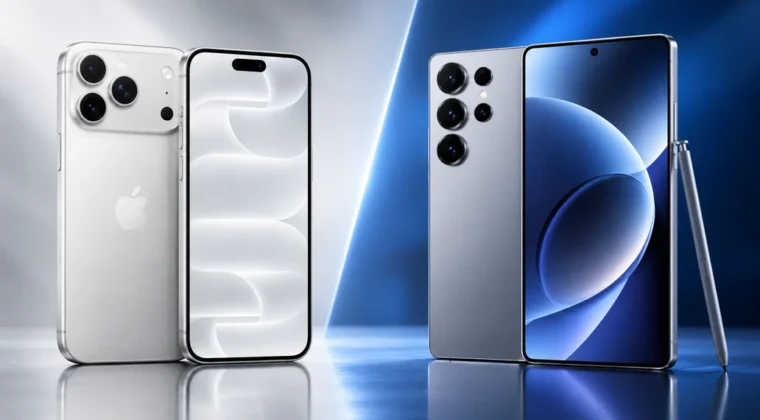
For anyone deciding between a new iPhone and a new Samsung flagship this year, 2026 offers two genuinely strong options. Apple officially unveiled the iPhone 18 Pro and iPhone 18 Pro Max on September 9, 2026, at its “Surprise and Shine” keynote — the first major hardware event under new CEO John Ternus. Samsung, meanwhile, launched the Galaxy S26 Ultra back in February at Galaxy Unpacked, giving it a several-month head start in the market. Both devices sit at the top of their respective lineups, and both come with genuinely significant upgrades over their predecessors. Here’s how they compare, category by category. For more on this year’s phone launches, see our roundup of the biggest smartphone launches of September 2026.
Display
The iPhone 18 Pro keeps Apple’s familiar dual-size approach: a 6.3-inch display on the standard Pro model and a 6.9-inch display on the Pro Max, both using LTPO OLED panels with ProMotion for adaptive refresh rates, and a redesigned Dynamic Island now capable of showing three Live Activities simultaneously.
The Galaxy S26 Ultra sticks with its signature 6.9-inch Dynamic LTPO AMOLED display, running at up to 120Hz with a claimed peak brightness around 2600 nits and Corning Gorilla Armor 2 protection, plus Samsung’s Privacy Display feature that limits viewing angles when enabled. Samsung’s display has traditionally had the edge on raw peak brightness figures, while Apple’s ProMotion implementation is often praised for its smoothness and color consistency across content types.
Performance
The iPhone 18 Pro is powered by Apple’s new A20 Pro chip, the company’s first iPhone processor built on TSMC’s 2-nanometer process. It features a six-core CPU, a seven-core GPU, and a dual 16-core Neural Engine, with Apple claiming roughly 50% more memory bandwidth than the previous A19 Pro and up to 40% better sustained performance thanks to a larger vapor chamber and new chip packaging designed to manage heat more effectively during demanding tasks.
The Galaxy S26 Ultra runs on Qualcomm’s Snapdragon 8 Elite Gen 5, paired with 12GB or 16GB of RAM depending on configuration. Samsung has generally paired its Ultra-series flagships with Qualcomm’s latest silicon for global markets, and the 8 Elite Gen 5 represents a solid generational step up in both raw performance and AI-focused processing tasks.
In practical terms, both chips are more than capable of handling anything a typical user — or even a demanding power user — will throw at them, and the performance gap that mattered in past years has narrowed considerably as both Apple and Qualcomm have converged on similarly advanced manufacturing processes.
Cameras
Apple’s headline camera upgrade for the iPhone 18 Pro is a new 48-megapixel Fusion Main camera with a genuine variable aperture, automatically adjusting between f/1.4 and f/4 depending on lighting and depth-of-field needs — a first for an iPhone. Apple says the widest aperture setting delivers roughly 50% better low-light performance, and new Pro camera controls add manual aperture, shutter speed, white balance, and histogram adjustments for users who want more creative control.
Samsung’s Galaxy S26 Ultra sticks with its established quad-camera formula: a high-resolution 200-megapixel main sensor, a 50-megapixel ultra-wide lens, a 50-megapixel periscope telephoto lens, and a secondary 10-megapixel telephoto lens for additional zoom flexibility. Samsung’s periscope zoom system has consistently been one of the strongest in the smartphone market for long-range photography, an area where the iPhone’s telephoto system has traditionally been more limited by comparison.
For most everyday photography, both systems produce excellent results, but the two takes reflect different philosophies: Apple’s variable aperture rewards more deliberate control, while Samsung’s higher-resolution, multi-lens setup favors flexibility across zoom ranges straight out of the camera app.
Battery Life and Charging
Apple has made a real battery push with this generation, with the iPhone 18 Pro rated for up to 36 hours of video playback and the Pro Max reaching up to 45 hours — a substantial increase attributed to the A20 Pro’s improved power efficiency alongside a larger battery cell. Apple has also introduced its own C2 cellular modem for this generation, which is expected to contribute to further power savings compared to third-party modem solutions used in prior years.
The Galaxy S26 Ultra carries a 5,000mAh battery with 60W wired fast charging and 25W wireless charging support. While Samsung’s raw battery capacity figure is larger on paper, direct video-playback comparisons are difficult since Apple and Samsung report battery life using different testing methodologies — real-world usage will vary considerably based on display brightness, network conditions, and individual usage patterns.
Software and AI Features
The iPhone 18 Pro ships with iOS 20 and Apple’s ongoing rollout of Apple Intelligence features, alongside deeper on-device AI integration enabled by the A20 Pro’s expanded Neural Engine. Apple has continued to expand Apple Intelligence’s writing tools, notification summaries, and image generation capabilities across its device lineup.
The Galaxy S26 Ultra runs Samsung’s One UI on top of Android, with a heavily AI-enhanced version of Bixby and deep integration with Google’s Gemini assistant for more advanced conversational and multimodal tasks. Samsung has increasingly positioned Gemini, rather than Bixby alone, as the primary AI experience for power users on its flagship devices.
Pricing
The iPhone 18 Pro starts at $1,199 for the base 256GB configuration, with the Pro Max starting at $1,299, and both available in higher storage tiers up to 2TB. Pre-orders opened September 12, 2026, with retail availability beginning September 18.
The Galaxy S26 Ultra launched earlier in the year with an Indian starting price around ₹1,59,999 for its base configuration, positioning it at a broadly comparable premium price point to the iPhone 18 Pro lineup once regional pricing differences are accounted for.
Which Should You Buy?
If you’re deeply invested in Apple’s ecosystem — iMessage, AirDrop, Apple Watch, and Mac integration — or you specifically want a camera system with genuine manual creative control through the new variable aperture lens, the iPhone 18 Pro is the clear pick. Apple’s substantial battery life improvements this generation also make it a particularly strong choice for users who are frequently away from a charger.
If you prioritize an Android experience with deep Google Gemini integration, want the flexibility of a longer optical zoom range for photography, or simply prefer Samsung’s software customization options, the Galaxy S26 Ultra remains one of the strongest Android flagships available, even several months after its original launch.
Frequently Asked Questions
Which has a better camera, the iPhone 18 Pro or Galaxy S26 Ultra? Both are excellent, but they excel differently — the iPhone 18 Pro’s new variable aperture offers more manual creative control, while the Galaxy S26 Ultra’s 200MP main sensor and dedicated periscope telephoto lens generally provide stronger long-range zoom performance.
How much does the iPhone 18 Pro cost? The iPhone 18 Pro starts at $1,199 for 256GB, while the iPhone 18 Pro Max starts at $1,299.
Does the Galaxy S26 Ultra support Gemini AI? Yes, Samsung has deeply integrated Google’s Gemini assistant into the Galaxy S26 Ultra, positioning it as the primary AI experience alongside Samsung’s own Bixby.
When did the iPhone 18 Pro release? Apple announced the iPhone 18 Pro on September 9, 2026, with pre-orders opening September 12 and retail availability starting September 18.
Conclusion
Both the iPhone 18 Pro and the Galaxy S26 Ultra represent genuinely strong flagship phones for 2026, each leaning into their respective ecosystem’s strengths — Apple’s newfound camera flexibility and battery gains versus Samsung’s proven zoom camera system and Gemini-powered AI features. The right choice ultimately comes down to which ecosystem, iOS or Android, you’re already invested in, since both devices deliver excellent hardware within their own platforms.