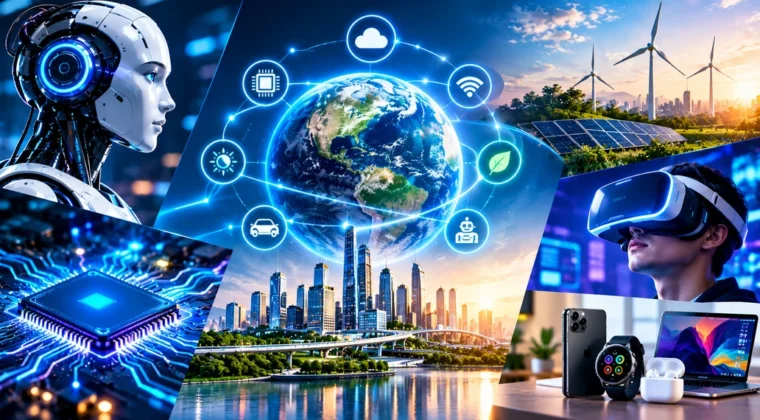
Technology continues to evolve at a pace that can feel dizzying, with new breakthroughs reshaping industries and daily life almost every year. In 2026, several major technology trends are converging to redefine how we work, communicate, and interact with the world around us. Unlike previous decades where change happened in relatively isolated waves — the personal computer era, the internet era, the smartphone era — today’s shifts are happening simultaneously and reinforcing one another. AI is accelerating robotics. Faster connectivity is enabling new wearable capabilities. Cloud infrastructure is powering both. This article explores the most significant developments driving the technology landscape this year and what they mean for consumers and businesses alike.
1. The Continued Rise of Generative AI
Generative AI has moved well beyond chatbots and image generators. In 2026, it has become embedded into nearly every category of software, from productivity tools to creative applications. Key developments include:
- More capable AI models that can handle complex, multi-step reasoning tasks
- Integration of generative AI directly into operating systems and everyday apps
- Growing use of AI agents that can complete tasks autonomously with minimal human input
- Increased focus on making AI outputs more accurate and reliable through better grounding techniques
- Wider availability of specialized, smaller models optimized for specific tasks rather than one-size-fits-all systems
This shift means generative AI is no longer a novelty — it’s becoming foundational infrastructure across the technology industry, similar to how cloud computing or mobile connectivity became assumed building blocks over the past decade. Businesses that once viewed AI adoption as optional are increasingly finding that competitors who integrate it effectively can operate with meaningfully lower costs and faster iteration cycles. For more on this, see our AI & Artificial Intelligence category.
One of the more interesting sub-trends within generative AI is the shift toward “agentic” systems — AI that doesn’t just respond to a single prompt but can plan, execute, and adjust across multiple steps to complete a broader goal. This has implications well beyond chatbots, touching software development, customer service, research, and operations across almost every industry.
2. Advances in Robotics
Robotics technology has made significant strides, particularly in areas that were once considered years away from practical deployment:
- Humanoid robots being piloted in warehouse and manufacturing settings
- Improved dexterity and object manipulation capabilities powered by AI
- Growing use of robotics in healthcare, including surgical assistance and elder care support
- Consumer robotics expanding beyond simple vacuum cleaners into more capable home assistance devices
- Lower manufacturing costs bringing robotics within reach of small and mid-sized businesses, not just large industrial operations
While fully autonomous general-purpose robots remain a longer-term goal, specialized robotics applications are seeing real-world commercial deployment at increasing scale. Logistics and warehousing have been early adopters, largely because the environments are structured and predictable, making them easier for robots to navigate safely. As AI perception and decision-making improve, robots are increasingly able to operate in less controlled environments, including homes and outdoor settings.
Healthcare robotics in particular deserves attention. Surgical robots have existed for years, but 2026 has seen growing interest in robotics for rehabilitation, elder care support, and even mental health companionship — raising both exciting possibilities and important ethical questions about the role of automation in deeply human contexts.
3. Quantum Computing Progress
Quantum computing remains an emerging field, but 2026 has seen meaningful progress toward practical applications:
- Improved error correction techniques that make quantum computers more stable and reliable
- Cloud-based access to quantum computing resources, allowing broader experimentation
- Early applications in cryptography, materials science, and complex optimization problems
- Continued investment from both governments and major technology companies
- Growing collaboration between academic researchers and private industry to accelerate practical use cases
While mainstream business applications remain limited for now, the foundational groundwork being laid today will likely shape computing capabilities for decades to come. Industries like pharmaceuticals, materials science, and logistics are watching quantum developments closely, since even modest improvements in specific optimization or simulation problems could translate into significant real-world value once the technology matures further.
It’s also worth noting the security implications of quantum computing. As quantum systems become more powerful, they pose a long-term threat to current encryption standards, prompting the cybersecurity industry to begin developing and adopting “quantum-resistant” cryptographic methods well ahead of when large-scale quantum decryption becomes practically feasible.
4. Extended Reality (XR) Matures
Virtual reality (VR), augmented reality (AR), and mixed reality (MR) — collectively known as extended reality — have continued to mature as both hardware and software improve. Notable developments include:
- Lighter, more comfortable headsets with improved battery life
- Growing enterprise adoption for training, design, and remote collaboration
- Expanding consumer use cases beyond gaming, including fitness and virtual meetings
- Improved integration between XR devices and everyday productivity tools
- More affordable entry-level devices broadening the potential consumer market
While mass-market adoption is still developing, XR technology has found solid footing in specific enterprise and gaming applications. Training simulations for high-risk industries — such as aviation, healthcare, and manufacturing — have proven to be one of the clearest return-on-investment use cases, since virtual environments allow employees to practice dangerous or costly scenarios safely and repeatedly.
On the consumer side, spatial computing devices that blend AR and VR capabilities are gradually pushing XR beyond its historical association with gaming, positioning it as a potential future computing platform in its own right, similar to how smartphones eventually surpassed desktop computers for many everyday tasks.
5. The Expansion of the Internet of Things (IoT)
The number of connected devices continues to grow rapidly, spanning everything from home appliances to industrial sensors. Key trends include:
- Increased focus on interoperability standards, making it easier for devices from different manufacturers to work together
- Greater emphasis on IoT security, as the number of connected devices creates more potential attack surfaces
- Growth in industrial IoT applications for predictive maintenance and supply chain optimization
- Smart city initiatives expanding the use of connected sensors for traffic, utilities, and public safety
- Edge computing increasingly paired with IoT deployments to process data closer to its source
The push toward interoperability standards has been particularly significant, as fragmented ecosystems have historically frustrated consumers trying to build a cohesive smart home. Industry-wide collaboration on shared standards is gradually making it easier for devices from different brands to work together seamlessly, reducing one of the biggest barriers to broader smart home adoption.
On the industrial side, predictive maintenance powered by IoT sensors has demonstrated clear cost savings for manufacturers, allowing equipment issues to be identified and addressed before they cause costly downtime — a compelling example of how connected technology delivers measurable business value beyond consumer convenience.
6. 5G Maturity and the Path Toward 6G
5G networks have continued to expand in coverage and reliability, while early research and development for 6G technology is already underway. Current trends include:
- Broader 5G coverage reaching more rural and underserved areas
- New use cases enabled by low-latency, high-bandwidth connectivity, including remote surgery and autonomous vehicle communication
- Early-stage 6G research focused on even faster speeds and more reliable connections for future applications
- Growing importance of network infrastructure for supporting AI-powered applications that require significant bandwidth
- Increased private 5G network deployments for enterprises with specific security or reliability needs
As 5G networks mature, the applications that depend on their low latency and high bandwidth are becoming more sophisticated. Remote surgery, once purely theoretical, has moved into limited real-world trials, relying on network reliability that simply wasn’t achievable with earlier generations of mobile connectivity. Similarly, autonomous vehicle systems increasingly depend on fast, reliable vehicle-to-everything (V2X) communication, which benefits directly from continued 5G infrastructure investment.
7. Wearable Technology Goes Beyond Fitness Tracking
Wearable devices have expanded well beyond basic step counting and heart rate monitoring. Modern wearables now offer:
- Advanced health monitoring, including blood oxygen levels, sleep quality analysis, and early detection of certain health conditions
- Integration with AI-powered coaching and personalized health insights
- Expanding form factors, including smart rings and other discreet wearable formats
- Growing focus on mental wellness tracking alongside physical health metrics
- Improved battery life and comfort, making continuous, all-day wear more practical
The shift toward preventative health insights is one of the most compelling developments in wearable technology. Rather than simply reporting data after the fact, newer devices increasingly aim to identify early warning signs of potential health issues, encouraging users to seek medical attention sooner than they might have otherwise. This positions wearables as a meaningful complement to traditional healthcare rather than just a fitness accessory.
8. Sustainable and Green Technology
Environmental concerns continue to drive innovation across the technology sector. Notable trends include:
- Increased investment in renewable energy technology, including more efficient solar panels and battery storage
- Growing adoption of electric vehicles alongside expanding charging infrastructure
- Technology companies committing to carbon-neutral or carbon-negative operations
- Innovations in recycling and sustainable manufacturing for electronic devices
- Data center efficiency improvements aimed at reducing the environmental footprint of AI and cloud computing
As AI adoption grows, so does scrutiny of its energy consumption, prompting significant investment in more energy-efficient chip designs and data center cooling technologies. This trend reflects a broader recognition within the technology industry that continued growth must be balanced against environmental responsibility, both for regulatory compliance and public reputation.
9. Cybersecurity Innovation Keeps Pace with Threats
As technology becomes more deeply embedded in daily life, cybersecurity innovation has had to keep pace with increasingly sophisticated threats. Key developments include:
- AI-powered threat detection systems that can identify and respond to attacks in real time
- Growing adoption of zero-trust security architectures across businesses of all sizes
- Increased focus on securing AI systems themselves against manipulation and misuse
- Expanding regulatory requirements around data protection and breach notification
- Greater investment in employee security awareness training as human error remains a leading cause of breaches
For practical guidance on staying protected, visit our Cybersecurity category. The rise of AI has introduced an interesting dynamic in cybersecurity — the same technology defenders use to detect threats faster is also being used by attackers to craft more convincing phishing attempts and automate parts of their attacks, creating an ongoing arms race between offensive and defensive applications of AI.
10. The Growing Importance of Digital Ethics and Regulation
As technology’s influence on society deepens, ethical and regulatory considerations have become central to the conversation. Key areas of focus include:
- AI governance frameworks aimed at ensuring transparency and accountability
- Data privacy regulations continuing to evolve and expand globally
- Growing public discourse around the societal impact of algorithmic decision-making
- Increased scrutiny of technology’s environmental and labor market impacts
- Ongoing debate about appropriate limits on AI use in sensitive areas like hiring, lending, and law enforcement
Organizations like the World Economic Forum have highlighted the importance of balancing innovation with responsible governance as technology continues to advance rapidly. Regulatory approaches vary significantly across regions, with some governments favoring stricter oversight and others prioritizing innovation-friendly frameworks — a tension that’s likely to continue shaping the global technology landscape for years to come.
What These Trends Mean for Businesses and Consumers
For businesses, staying informed about these technology trends is essential for remaining competitive, whether that means adopting AI tools, strengthening cybersecurity postures, or exploring new connectivity capabilities enabled by 5G and IoT. Companies that treat technology adoption as a strategic priority — rather than a reactive afterthought — tend to be better positioned to capture efficiency gains and respond quickly to market shifts.
For consumers, these trends translate into smarter devices, more personalized digital experiences, and growing considerations around privacy and digital wellbeing. As technology becomes more capable and more deeply woven into everyday routines, staying informed helps individuals make better decisions about which tools genuinely add value to their lives versus which simply add complexity.
How to Stay Ahead of These Trends
For readers wanting to stay current with these fast-moving developments, a few practical habits can help:
- Follow trusted technology news sources regularly rather than relying solely on social media summaries, which can lack nuance
- Experiment with new tools cautiously — try new technology in low-stakes settings before fully integrating it into critical workflows
- Prioritize security fundamentals even as new technologies emerge, since basic practices like strong passwords and software updates remain foundational
- Engage with communities and forums relevant to your industry, where practitioners often share practical, real-world experiences with new tools
- Revisit your technology stack periodically, since tools that were cutting-edge a few years ago may now have better alternatives
Frequently Asked Questions
Which technology trend will have the biggest impact in 2026? Generative AI and its integration across software platforms is widely considered the most transformative trend currently reshaping both consumer and business technology.
Is quantum computing ready for mainstream business use? Not yet. While progress continues, practical, widespread business applications of quantum computing are still likely several years away for most industries.
How can businesses keep up with rapidly changing technology trends? Staying informed through trusted technology news sources, investing in employee training, and adopting new tools incrementally rather than all at once are effective strategies for keeping pace with change.
Are these technology trends relevant to small businesses, or only large enterprises? Many of these trends — particularly AI tools, cybersecurity practices, and cloud infrastructure — are increasingly accessible and relevant to small businesses, not just large corporations with big technology budgets.
Conclusion
The technology landscape in 2026 reflects a period of rapid convergence — AI, robotics, connectivity, and sustainability are increasingly intertwined, reshaping industries and everyday life simultaneously. Staying informed about these trends helps both businesses and individuals make smarter decisions about the tools and technologies they adopt. For more in-depth coverage of these developments, explore our full range of categories on Today Tech Times.