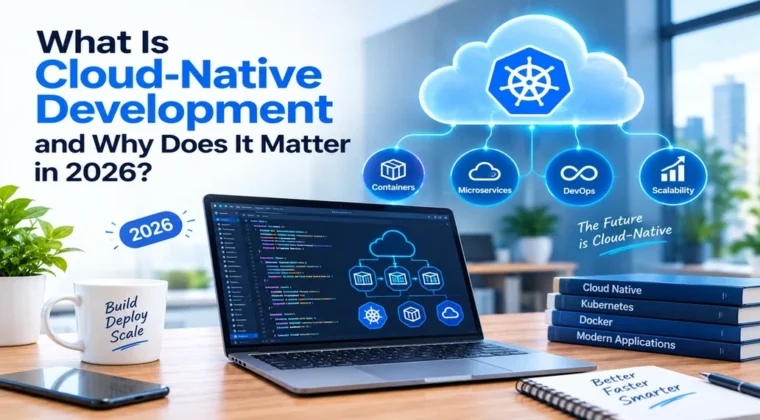
Software development has changed dramatically over the past decade, and one of the biggest shifts has been the move toward cloud-native development. In 2026, this approach isn’t just a trend for tech giants — it’s become a standard practice for businesses of all sizes that want to build software capable of scaling quickly, recovering from failures automatically, and adapting to changing demand.
What Does Cloud-Native Development Actually Mean?
Cloud-native development refers to building and running applications specifically designed to take full advantage of cloud computing environments, rather than simply moving traditional software onto cloud servers. This typically involves breaking applications into smaller, independent components called microservices, packaging them using containers, and managing them with orchestration tools that automatically handle scaling and recovery.
The key difference from traditional development is intent — cloud-native applications are built from the ground up to be flexible, resilient, and scalable, rather than adapted afterward to run in the cloud. This distinction matters because software that’s simply “lifted and shifted” into the cloud often fails to take advantage of the cloud’s real benefits, such as automatic scaling and distributed resilience.
Core Principles of Cloud-Native Development
1. Microservices Architecture
Instead of building one large, monolithic application, cloud-native development breaks software into smaller, independent services that each handle a specific function. This makes it easier to update, scale, or fix individual parts of an application without affecting the entire system. If the payment processing service needs an update, for example, the rest of the application can continue running without interruption.
2. Containerization
Containers package an application along with everything it needs to run — code, libraries, and dependencies — into a single, portable unit. This ensures consistent performance whether the application is running on a developer’s laptop, a testing environment, or a massive cloud data center, eliminating the classic “it works on my machine” problem that has long plagued software development.
3. Automated Scaling and Recovery
Cloud-native systems are designed to automatically scale up during high demand and scale back down when demand drops, optimizing both performance and cost. They’re also built to detect and recover from failures without requiring manual intervention — if one instance of a service crashes, the system automatically spins up a replacement, often before users even notice an issue.
4. Continuous Delivery
Cloud-native development typically pairs with continuous integration and continuous delivery (CI/CD) pipelines, allowing teams to release updates frequently and reliably rather than through large, infrequent releases. This means new features and bug fixes can reach users in hours or days rather than weeks or months.
5. Declarative Infrastructure
Modern cloud-native systems increasingly use “infrastructure as code,” where the entire application environment is defined in configuration files rather than manually set up. This makes environments easier to replicate, audit, and roll back if something goes wrong.
Why Businesses Are Adopting Cloud-Native Development in 2026
Faster Time to Market
Breaking applications into smaller, independently deployable pieces allows development teams to work in parallel and release updates faster, which is a significant competitive advantage in fast-moving industries where being first to market with a new feature can determine which company wins customers.
Better Resilience
Because cloud-native applications are distributed across multiple services, a failure in one component doesn’t necessarily bring down the entire system — a critical advantage for businesses that can’t afford downtime, particularly in sectors like e-commerce and finance where outages directly translate into lost revenue.
Cost Efficiency
Automated scaling means businesses only pay for the computing resources they actually use, rather than maintaining excess capacity for peak demand that may only occur occasionally, such as during a seasonal sales event. This “pay for what you use” model can result in substantial savings compared to traditional infrastructure planning.
Improved Developer Productivity
Standardized, containerized environments reduce the friction developers face when setting up new projects or onboarding to existing ones, allowing teams to focus more time on building features rather than troubleshooting environment inconsistencies.
This shift toward more efficient, scalable infrastructure connects closely with broader trends in enterprise technology. Our earlier article on emerging technology transforming businesses and everyday life explores how these infrastructure changes are reshaping business operations more broadly.
Challenges of Cloud-Native Development
Despite its advantages, transitioning to cloud-native development isn’t simple. Common challenges include:
- Increased complexity in managing many small services instead of one large application, which requires more sophisticated monitoring and coordination tools
- Security considerations, since each microservice represents a potential point of vulnerability, and securing distributed systems is inherently more complex than securing a single application
- Skills gaps, as cloud-native development requires expertise in containerization, orchestration, and distributed systems — skills that many existing development teams need to build over time
- Higher upfront investment in tooling and infrastructure before cost savings materialize, which can make the transition harder to justify for smaller organizations
- Cultural shifts, since cloud-native development often requires changes to how teams are organized and how they collaborate, not just changes to the technology itself
Organizations considering this shift often benefit from starting with a single, well-scoped application before migrating their entire software portfolio, allowing teams to build expertise gradually rather than attempting a complete overhaul all at once.
Cloud-Native Development and Startups
For software startups in particular, building cloud-native from day one offers a significant advantage, since it avoids the costly process of re-architecting legacy systems later. Startups that build cloud-native from the outset are often able to scale far more smoothly when they experience rapid growth, without the painful infrastructure rewrites that many older companies now face. Our article on how software startups develop innovative products and attract more customers touches on how modern development practices help new companies compete with established players.
The Role of Cloud-Native Development in AI Adoption
As businesses increasingly integrate AI into their products and internal tools, cloud-native architecture plays a supporting role that’s easy to overlook. AI workloads often require significant, variable computing resources — heavy during training or high-demand periods, lighter otherwise. Cloud-native infrastructure’s ability to scale resources up and down automatically makes it a natural fit for supporting AI-driven features without requiring businesses to over-provision expensive hardware they’ll rarely fully use.
Final Thoughts
Cloud-native development has moved from being an emerging best practice to an industry standard in 2026. As businesses increasingly compete on speed, reliability, and the ability to scale efficiently, adopting cloud-native principles is becoming less of an option and more of a necessity for staying competitive in a software-driven economy — one where the ability to adapt quickly often matters just as much as the quality of the software itself.