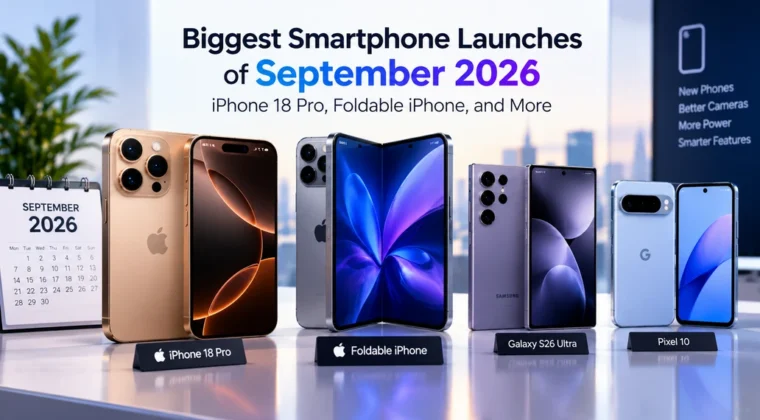
September 2026 has turned into one of the busiest smartphone launch months in recent memory. More than twenty new phones are arriving from Apple, Samsung, Xiaomi, Huawei, Vivo, Oppo, Honor, and iQOO within just a few weeks — a scheduling pile-up driven by new flagship chipsets from Qualcomm and MediaTek, Apple’s first foldable device, and Huawei moving its usual Mate series launch window forward.
For anyone trying to decide what to buy this season — or simply trying to keep up with the flood of announcements — this guide breaks down the most important smartphone launches of September 2026, what makes each one notable, and how AI has become the defining feature category across nearly every price tier.
Why September 2026 Is Such a Crowded Launch Window
A few factors converged to make this month unusually packed. Apple’s high-end iPhone event lines up with the debut of its long-rumored first foldable device. Huawei has pulled its Mate series launch forward from its traditional November slot. And new flagship silicon from Qualcomm and MediaTek is pressuring Android manufacturers to get their latest devices to market as quickly as possible, rather than waiting for their usual release cadence.
The practical result for consumers: an unusually wide range of choice compressed into a short window, spanning ultra-premium foldables, mainstream flagships, and AI-focused mid-range devices.
Apple iPhone 18 Pro, Pro Max, and the First Foldable iPhone
Apple’s September 9 event put the spotlight on three devices: the iPhone 18 Pro, iPhone 18 Pro Max, and — for the first time ever — a foldable iPhone.
iPhone 18 Pro and Pro Max The Pro models are expected to retain familiar 6.3-inch and 6.9-inch display sizes while making the jump to Apple’s new 2nm A20 Pro chipset, paired with 12GB of RAM and Apple’s own in-house C2 modem — a notable shift away from third-party modem suppliers. Apple is also reportedly shrinking the Dynamic Island further by relocating more Face ID hardware beneath the display, continuing a multi-year trend toward a cleaner front-of-screen design.
The Foldable iPhone Apple’s first foldable is arguably the bigger story of the event. Reports point to a 7.8-inch inner display and a 5.3-inch cover screen, housed in a titanium-and-aluminum body. Interestingly, rumors suggest Apple may replace Face ID entirely on this model with a Touch ID sensor integrated into the power button — a notable departure from the company’s recent design direction. The foldable is also expected to ship with a dual rear camera setup, skipping a telephoto lens despite a price expected to land above $2,000.
For a company that has resisted the foldable form factor far longer than its Android competitors, this launch represents a significant strategic pivot — and one the rest of the industry will be watching closely.
Samsung Galaxy S26 FE
Samsung has already made its Galaxy S26 FE official ahead of a September 18 India sale date. As the “Fan Edition” of Samsung’s flagship line, the S26 FE is positioned to deliver flagship-style specs — including a 120Hz AMOLED display — at a more accessible price point than the standard Galaxy S26 lineup. It’s a strategy Samsung has used successfully in previous generations: offering the core flagship experience with select trade-offs to hit a lower price bracket, appealing to buyers who want premium performance without the ultra-flagship cost.
Xiaomi 18 Series and Xiaomi 18 Fold
Xiaomi has an unusually packed September planned, headlined by the Xiaomi 18 Fold, powered by the company’s in-house Xring O3 processor and next-generation LPDDR6 memory. The Fold is expected to feature a 7.6-inch inner display, a 6,000mAh battery, 67W wired charging, 50W wireless charging, and a 200MP main camera — specs that would put it firmly in competition with Samsung’s and Huawei’s top foldables.
Xiaomi is also expected to launch its broader Xiaomi 18 series alongside the Xiaomi Pad 9 Pro Max, rounding out a multi-device announcement window rather than a single hero product launch.
Google Pixel 11 Series (Already Launched in August)
While technically launched just ahead of September at Google’s Made by Google event, the Pixel 11 series remains highly relevant to this month’s buying conversation. The lineup — Pixel 11, Pixel 11 Pro, Pixel 11 Pro XL, and Pixel 11 Pro Fold — runs on Google’s new Tensor G6 chipset and ships with Android 17, featuring deep Gemini AI integration across camera processing, real-time translation, and search.
The base Pixel 11 features a 6.3-inch OLED display, 12GB of RAM, up to 512GB of storage, a triple rear camera system (48MP, 13MP, and 10.8MP sensors), a 10.5MP front camera, and a 4,985mAh battery. The Pro and Pro XL models step up to LTPO 120Hz displays and up to 16GB of RAM, while the Pro Fold rounds out Google’s foldable ambitions with an 8-inch inner display and 6.5-inch outer display.
Why AI Has Become the Defining Feature Category
Across nearly every launch this September, one theme repeats: AI is no longer a marketing add-on — it’s the core selling point. Industry data shows that more than 80% of flagship phones released in 2026 now include dedicated neural processing units (NPUs), up from roughly half just two years earlier. That shift matters because on-device AI processing — as opposed to routing requests to the cloud — handles common tasks like photo enhancement and voice recognition dramatically faster, while keeping personal data on the device rather than sending it to a remote server.
This has real practical implications for buyers:
- On-device processing means AI features like live translation, photo editing, and voice assistants work faster and function even with a weak or absent internet connection
- Privacy benefits come from keeping sensitive data — photos, voice recordings, personal messages — processed locally rather than uploaded to the cloud
- Even mid-range phones now run meaningful AI tasks locally, a capability once reserved exclusively for premium flagships
Apple, Google, and Samsung have each taken a distinct approach: Apple Intelligence emphasizes live translation and generative tools like genmoji; Google leans heavily on Gemini for real-time search, translation, and camera intelligence; Samsung continues expanding AI-driven photography and productivity features across its Galaxy lineup.
What to Look for When Buying an AI Phone in 2026
With AI now central to the smartphone buying decision, here’s what actually matters when comparing devices:
- Dedicated NPU hardware — the presence of on-device neural processing hardware, not just cloud-routed AI features, determines real-world speed and privacy
- Real-time translation and transcription quality — increasingly useful for travel, business, and accessibility
- Computational photography — AI-driven image processing now matters more for everyday photo quality than raw megapixel count
- Battery efficiency under AI workloads — on-device AI processing can be power-intensive; check real-world battery benchmarks, not just spec-sheet capacity
- Software update commitment — AI features evolve rapidly, so a manufacturer’s update track record affects how long a phone stays genuinely current
Huawei’s Accelerated Mate Series Launch
One of the more unusual developments driving September’s crowded calendar is Huawei’s decision to move its flagship Mate series launch forward from its traditional November window. This earlier timing puts Huawei in more direct competition with Apple and Samsung’s September announcements than in previous years, rather than allowing those flagships several months of uncontested market attention before Huawei’s own launch. For a company that has continued to innovate aggressively in foldable design and camera technology despite ongoing supply chain constraints, the earlier launch window signals a more assertive competitive posture heading into the holiday shopping season.
Vivo, Oppo, iQOO, and the Mid-Tier AI Push
While Apple, Samsung, and Xiaomi dominate headlines, the broader September launch wave also includes significant activity from Vivo, Oppo, iQOO, and Honor — brands that have increasingly focused their competitive energy on the mid-range and upper-mid-range segments rather than chasing the ultra-premium flagship crown directly.
This segment is where the “AI trickle-down” effect is most visible. Features that were exclusive to $1,000-plus flagships just two years ago — on-device AI photo editing, real-time translation, and intelligent camera scene detection — are now standard even on phones priced well under $500. Chipset makers Qualcomm and MediaTek have both released new mid-tier silicon this cycle specifically designed to support on-device AI processing without the power and cost overhead of true flagship chips, enabling this rapid democratization of AI features across price tiers.
For budget-conscious buyers, this means the gap between what a flagship phone can do and what a well-chosen mid-range phone can do has narrowed considerably when it comes to everyday AI-powered features, even if raw performance, camera hardware, and build materials still favor the premium tier.
Chipset Wars: Why New Silicon Is Driving the Launch Calendar
It’s worth understanding why chipset timing has such an outsized influence on smartphone release schedules. Qualcomm and MediaTek both typically unveil their newest flagship and upper-mid-range processors in the second half of the year, and phone manufacturers race to be among the first to market with devices built on that new silicon — since being first often translates into a meaningful marketing and sales advantage during the crucial holiday shopping period.
This year’s new chipsets bring meaningful improvements in AI processing efficiency, allowing more sophisticated on-device models to run without draining battery life as aggressively as previous generations. This is a big part of why so many manufacturers, across such a wide range of price points, are launching devices within the same compressed few-week window rather than spreading their releases more evenly throughout the year.
Camera Technology: Beyond the Megapixel Race
While megapixel counts remain a common marketing headline — with several September launches touting 200MP main sensors — the more meaningful camera improvements this cycle are happening in computational photography rather than raw sensor resolution. AI-driven image processing now handles tasks like real-time scene recognition, multi-frame noise reduction, and automatic subject isolation for portrait-style shots, often making a bigger practical difference in everyday photo quality than sensor megapixel count alone.
Buyers comparing camera systems across this crop of new launches are better served focusing on real-world sample photos and video footage rather than spec-sheet megapixel comparisons, since AI processing differences between manufacturers can produce dramatically different results even from similar underlying hardware.
Foldables: From Niche to Mainstream Battleground
Perhaps the clearest trend of September 2026 is how central foldable devices have become to flagship strategy. With Apple, Samsung, Xiaomi, and Google all fielding foldable devices this cycle, the form factor has moved decisively from early-adopter niche to a genuine flagship battleground. Expect pricing, display durability, and hinge engineering to be the key differentiators buyers weigh most heavily as this segment matures.
For more on how AI hardware trends are shaping the broader tech industry, check out our coverage of agentic AI adoption in 2026 and how cloud infrastructure is adapting to support on-device and cloud-hybrid AI workloads.
Frequently Asked Questions
Which phone is the biggest launch of September 2026? Apple’s first foldable iPhone is arguably the most significant launch of the month, given it represents the company’s long-awaited entry into a form factor competitors have offered for years.
Should I buy a foldable phone in 2026? Foldables have matured significantly in durability and software support, but they still carry a price premium and, in some cases, camera trade-offs compared to traditional flagships. They make the most sense for buyers who value screen real estate for productivity or media consumption.
What does an NPU actually do in a smartphone? A Neural Processing Unit is dedicated hardware built specifically to handle AI computations — like image recognition or language processing — locally on the device, rather than sending that data to the cloud for processing.
Is the Galaxy S26 FE a good alternative to the standard Galaxy S26? For buyers who want most of the flagship experience at a lower price, Fan Edition models have historically offered strong value, typically trading off camera hardware or premium materials rather than core performance.
Should You Upgrade Now or Wait?
With so many devices launching within weeks of each other, timing a purchase can feel overwhelming. A few practical guidelines can help:
If your current phone is more than three to four years old and struggling with battery life or software support, most of September’s new launches represent a meaningful upgrade regardless of which specific model you choose — the baseline AI capability, camera processing, and performance across this generation are substantially ahead of devices from just a few years ago.
If you’re specifically interested in foldables, it may be worth waiting for early reviews and durability reports before committing, particularly for first-generation devices like Apple’s foldable iPhone. Hinge mechanisms and display durability have historically improved significantly between a manufacturer’s first and second-generation foldable devices.
If budget is the primary constraint, consider waiting a few weeks after launch, since previous-generation flagships and current mid-range devices typically see meaningful price reductions once a new flagship cycle begins, often delivering excellent value with only modest capability trade-offs.
If AI features are your main priority, focus less on brand loyalty and more on comparing specific on-device AI capabilities — real-time translation quality, computational photography performance, and battery efficiency under AI workloads — since these vary meaningfully between manufacturers even at similar price points and marketing claims.
Trade-In and Sustainability Considerations
With so many new devices launching simultaneously, the environmental footprint of smartphone upgrade cycles has become a more prominent part of the buying conversation. Most major manufacturers now offer trade-in programs that credit the value of an older device toward a new purchase, and refurbished device markets have matured considerably, offering a genuine alternative for buyers who want current-generation performance without the premium of a brand-new device.
For buyers weighing whether to upgrade this cycle, it’s worth considering that the AI feature gap between a two-year-old flagship and this September’s new releases is often more meaningful in daily use than the gap was in previous generations, given how much of this year’s launch cycle centers on on-device AI capability rather than incremental hardware refinements alone. That said, a well-maintained phone from the past two to three years will still handle the vast majority of everyday tasks perfectly well, and holding onto a device longer remains one of the most effective ways to reduce the environmental impact of smartphone consumption.
Pricing Trends Across This Launch Cycle
Pricing across September’s launches reflects a widening gap between ultra-premium foldables and increasingly capable mainstream flagships. Foldable devices from Apple, Samsung, and Xiaomi are generally clustering above the $1,800-$2,000 mark, reflecting both the cost of advanced folding display technology and the premium positioning manufacturers are using to establish these devices as aspirational flagship statements. Meanwhile, standard flagship and Fan Edition-style devices continue to hold relatively steady pricing year-over-year despite meaningful AI and camera improvements, suggesting manufacturers are absorbing some component cost increases rather than passing them fully onto consumers, likely to maintain competitiveness in a crowded launch window. Mid-range devices from Vivo, Oppo, iQOO, and Honor remain the most price-competitive segment of this cycle, continuing to close the capability gap with flagships faster than their prices are rising, which is good news for budget-conscious buyers who don’t need cutting-edge foldable technology.
Final Thoughts
September 2026’s smartphone launch season reflects a broader industry pattern: AI capability, not raw specifications alone, is now the primary battleground for flagship devices. Whether it’s Apple’s first foldable, Samsung’s value-focused Fan Edition, or Xiaomi’s aggressive foldable push, every major manufacturer is racing to prove that on-device intelligence — not just screen size or camera megapixels — is what defines the modern smartphone experience.
Stay with Today Tech Times‘ Mobile & Gadgets section for hands-on reviews and continuing coverage as these devices reach the market.